

Our custom woodwork · Made in Dubai since 1985
Custom Woodwork and Joinery in Dubai
Custom woodwork covers a wider range of trades than many quotations make clear. Carpentry, joinery, millwork and fitted furniture can all involve timber or board, but they describe different kinds of work. Knowing which one you need helps you compare the scope, materials and installation responsibility, rather than comparing totals that include different things.
We have made custom woodwork in Dubai since 1985. We produce the components in our workshop in Ras Al Khor, and the team responsible for the build installs them. One company measures, manufactures and fits the work, so there is one point of responsibility for the agreed result.
The words explained
These terms often overlap in everyday conversation. The distinctions below are useful when you are describing a project or checking what a quotation includes.
| Term | What it means | Typical examples |
|---|---|---|
| Carpentry | Working with timber on site, including structural and repair work | Studwork, door hanging, floor joists and repairs |
| Joinery | Making components in a workshop before fitting them on site | Doors, windows, stair parts and fitted furniture |
| Millwork | Joinery made on industrial machinery, often to repeatable dimensions or profiles | Mouldings, panelling, reception counters and repeated units |
| Fitted furniture | Joinery designed for one measured space | Wardrobes, TV units, vanities and kitchen cabinets |
| Woodwork or woodworking | The broad term covering all of the above | Anything made from timber, veneer or board |
A project may involve several categories. A fitted wardrobe is workshop joinery, but skirting adjustments and small repairs around it may be completed on site. Describe the outcome you need and we will identify the appropriate work rather than expecting you to choose the trade label first.
What our custom woodwork includes
- Fitted and walk-in wardrobes with sliding or hinged doors.
- Kitchen cabinets, islands, pantry and larder joinery.
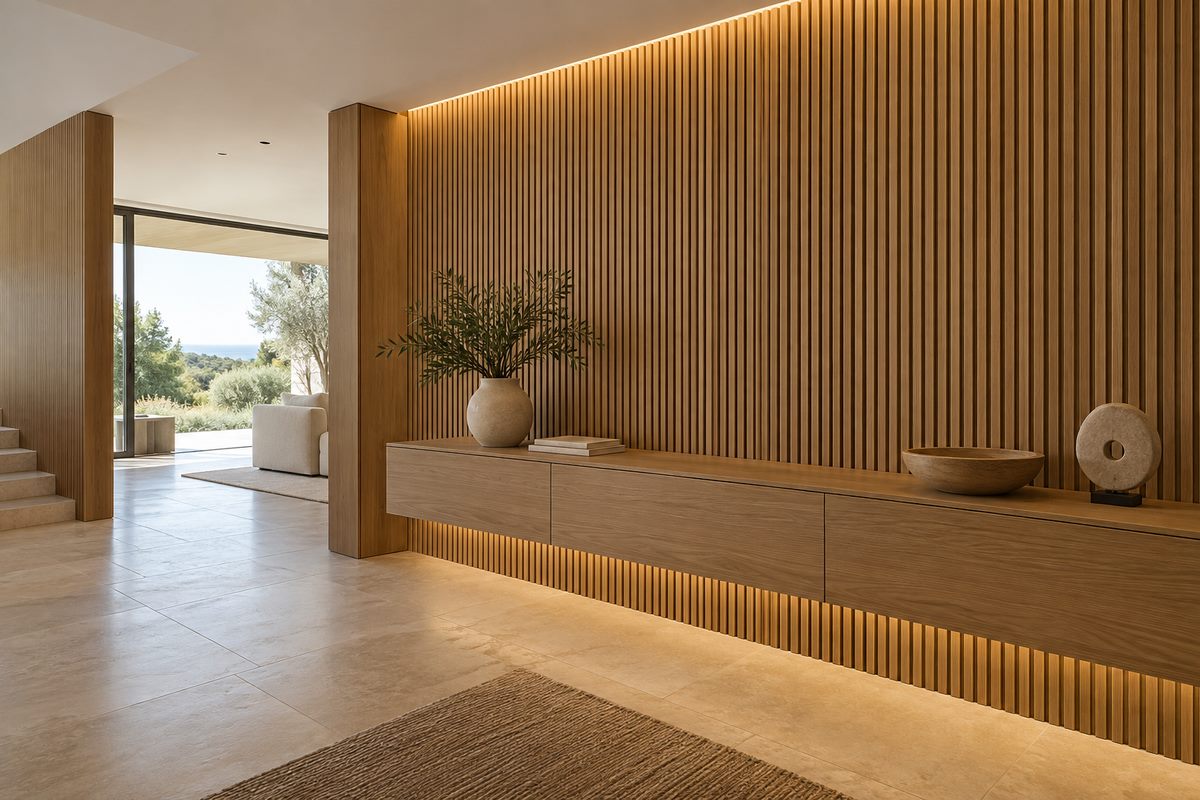
- TV units, media walls and floating consoles.
- Bathroom vanities, vanity countertops and basin units.
- Beds, bunk beds, storage beds and bedroom furniture.
- Architectural design services for interiors that need drawings as well as build work.
- Dining tables, coffee tables and console tables.
- Office furniture for workplaces, boardrooms and reception areas.
- Benches, window seats and built-in seating.
- Outdoor furniture, pergolas and garden seating, built for the climate.
- Bookshelves, display units and floating shelves.
- Doors, door frames, architraves and skirting.
- Wooden staircases, handrails and balustrades.
- Wall panelling, cladding and decorative timber features.
- Reception counters and fitted commercial joinery.
- Laundry, utility-room and general storage joinery.
The list describes common work rather than fixed products. We specify each piece around its use and location. Wet-area joinery needs protected edges and suitable substrates. A heavily used reception counter needs a durable surface and service access. A feature wall needs careful setting out so the lines meet surrounding doors, sockets and ceilings cleanly.
Materials we work with
The material should follow the job. A more expensive option is not automatically more suitable, and a cheaper board can be the correct choice when it is used in the right place and finished properly.
| Material | Where it is used | Why it is selected |
|---|---|---|
| Veneer | Doors, panels and feature walls | Provides a real timber surface and allows matching grain across panels |
| Solid timber | Tables, benches, frames and exposed edges | Can be repaired, sanded and refinished over time |
| MDF and MR-MDF | Painted or sprayed joinery | Stable, smooth and suitable for a consistent coated finish |
| Marine ply | Bathrooms, wet areas and utility rooms | Provides a stronger moisture-resistant substrate when edges are sealed |
| Plywood | Carcasses and structural joinery | Strong for its weight and dimensionally stable |
| High-pressure laminate | Hard-working doors, shelves and surfaces | Durable and available in many colours and textures |
The visible sample does not tell the full story. The substrate, edge detail, backing and fixing method also affect performance. We identify these in the specification. For veneer, we agree the grain direction and whether adjacent panels should be book-matched. For sprayed work, we confirm the sheen level and prepare a finished sample when close approval is important.
Why we manufacture and fit ourselves
One company sometimes manufactures the joinery to another company's drawing, and a third team installs it. When the wall is out of square or a service sits in the wrong place, responsibility can become unclear. We measure, make and fit our own custom woodwork. The person cutting the component can work from the actual site information, and the fitting team can return questions to the workshop directly.
This does not remove the need for an agreed drawing. The drawing records the dimensions, layout and interfaces with the room. The written specification records materials, finishes, hardware and inclusions. Together they provide the basis for manufacture, installation and the fixed quotation.
Planning the details before manufacture
A good site measure records more than the open width. Walls, floors and ceilings need level checks. Door swings, skirting, sockets, air-conditioning grilles and access panels must remain usable. Large pieces need a delivery route, lift dimensions and a plan for assembly. If the building restricts working hours or lift bookings, we need to know those conditions before we schedule installation.
A free site measurement lets us check these points before we cut materials. Where drawings come from an architect or designer, we review them against the measured site and raise conflicts before pricing or manufacture.
The same review covers how separate components meet. Grain direction across doors, shadow gaps beside walls, panel joints, handle clearances and the position of lighting all need decisions before production. Recording those decisions prevents the workshop and installation team from relying on different assumptions.
We also confirm which existing items remain in place and which trades must finish first. Accurate sequencing reduces avoidable cutting, removal and return visits during installation.
Custom woodwork and the Dubai climate
Dubai interiors move between air-conditioned conditions and hot, humid outside air. Solid timber and veneer can respond to those changes, so materials need suitable storage and acclimatisation before manufacture. Construction must also allow for normal movement instead of locking every part rigidly.
- Timber needs time to acclimatise before we machine and install it.
- Every cut edge in a wet area needs sealing, including hidden openings for pipes and fittings.
- Some finishes can fade in strong direct sunlight, so the room orientation should inform the selection.
- Concrete walls and floors are often out of square or level, so we allow for that during measurement and scribing.
- Air-conditioning grilles and ventilation routes must remain clear once we install fitted units.
Maintenance depends on the material. Laminates usually need simple wiping with a mild cleaner. Do not scrub sprayed finishes with abrasives. We can often repair or refinish solid timber, but you should still wipe up standing water quickly. We explain the relevant care points for the specified finish. Where a piece needs a new finish rather than new joinery, see furniture repainting in Dubai.
What affects the price of custom woodwork
Cost changes with the size and number of units, material, finish, curves or angled work, internal fittings and site access. Solid timber and veneer generally cost more than laminate. A sprayed gloss finish takes more preparation than a standard laminate surface. Drawers, soft-close hardware, pull-outs and lighting add components as well as fitting time.
Removal of old joinery, protection of occupied areas, restricted delivery periods and complex installation conditions can also affect the quotation. We identify these after the free site measure, so the price reflects the agreed work.
Frequently asked questions
A carpenter commonly works with timber on site, including framing, doors and repairs. A joinery workshop manufactures components on machinery before fitting them. Fitted wardrobes, kitchens and media units are typically joinery.
Usually. Send a photograph and, if possible, a finish or profile sample. Timber and coatings change with age, so we cannot promise an exact match until we compare samples, but the appearance can normally be brought close.
Yes. A project does not need to be a full fit-out. Send details of the shelf, replacement door, repair or single item and we will confirm whether we can schedule it.
Timing depends on the material, size, finish and current workshop schedule. You will receive dates once we agree the specification. We may plan larger fit-outs in stages.
Yes. For work beyond a simple item, you receive a drawing and written specification to review before manufacture begins.
Yes. Send the drawings and relevant schedules. We will review them against the site information and raise any manufacturing or installation issue before quotation or production.
The workshop is in Ras Al Khor, Dubai. Tell us the project location and we will confirm whether it is within the installation area.
Discuss your custom woodwork project
Send a photograph, drawing or description of what you need made. We will review the information, arrange a free site measure where appropriate, and prepare the specification and quotation.
Phone or WhatsApp: +971 54 766 1410
Email: ba***************@***il.com
Workshop: Ras Al Khor Industrial Area 2, Dubai, UAE
Trade licence: 128040
Send an enquiry
Related services
- Carpentry Services Dubai
- Wooden Wall Panelling & Cladding
- Wooden Staircases & Handrails
- Arabic Majlis Design & Fit-Out
- Commercial Joinery & Reception Counters in Dubai
- Office Renovation
- Custom Interior Doors
- Furniture Repainting in Dubai
- Architect Design
- Areas We Serve in Dubai
- Carpentry in Arabian Ranches
- Custom Furniture in Abu Dhabi